Link to Website Index: 
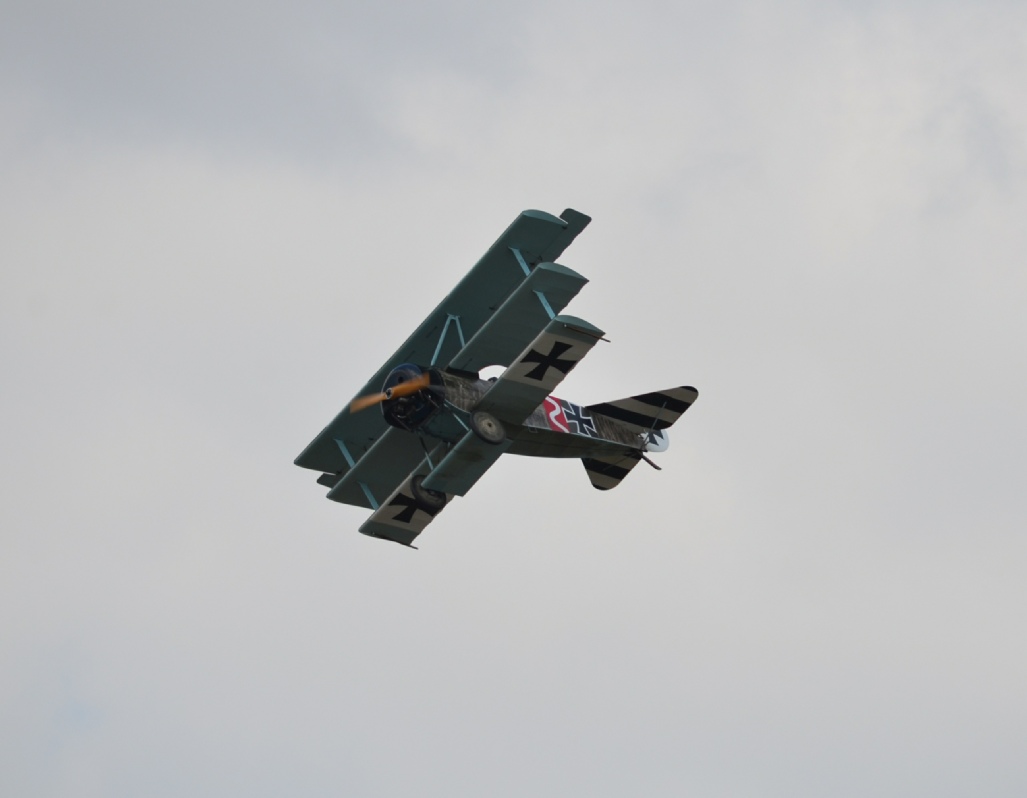
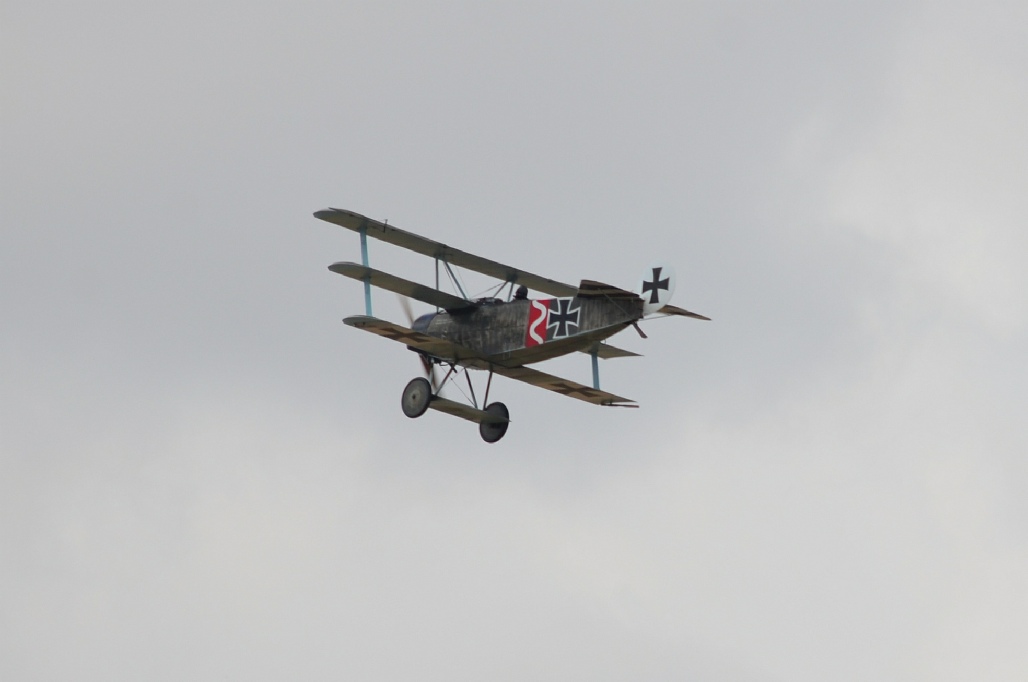
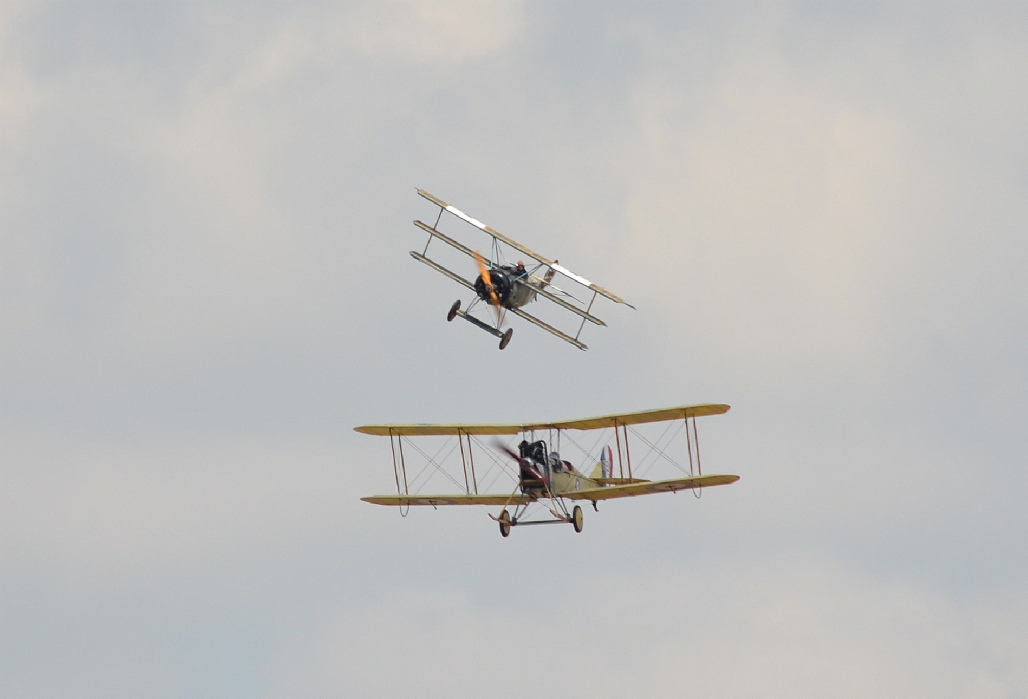
Fokker Dr.1
Jagdgeswader 1 (JG.1) “The Red Baron”, Imperial German Air Service
“Flying Circus” Western Front, 1918
Revell 1/72

Link to Website Index:
Text & Images © www.gengriz.co.uk (unless otherwise indicated)
TThe Fokker Dr.1 Driedecker (tri-
As with the “Tripe”, its triple wing arrangement gave good visibility, whilst its low wing loading, longitudinal instability and narrow wingspan gave it excellent manoeuvrability. However, like many German WW1 aircraft, it was structurally fragile and early aircraft became known for their tendency to lose wings in a dive. Poor construction was blamed and Fokker were forced to repair existing aircraft at their own expense; despite improvements, wing failures continued throughout its service with post war research showing that this was due in part at least to differing lift between its 3 wings, putting almost all load on the upper wing at speed.
Despite its success and fame, Allied aircraft quickly began to outpace the DR.1's speed and performance, so production ended in May 1918 when the far superior Fokker D.VII became available.
The Red Baron
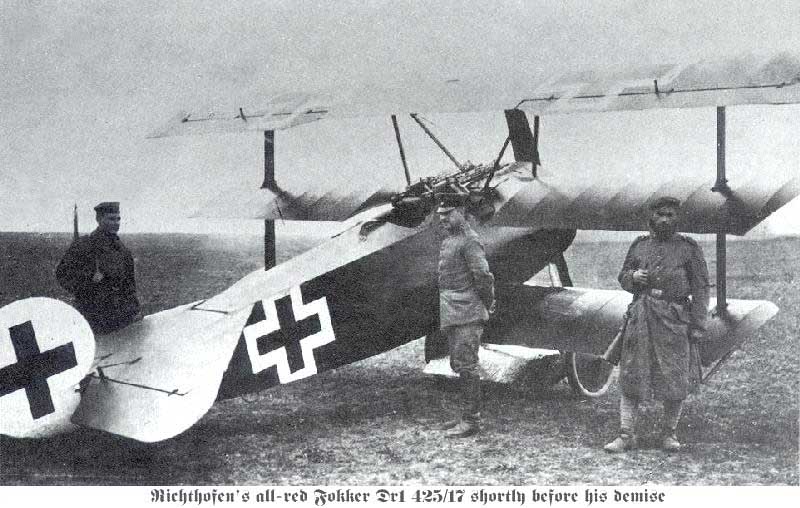
Rittmeister (Captain) Baron Manfred Von Richtofen is one of the best known pilots of the First World War. Flying his signature red coloured Fokker DR.1, he was officially credited with 80 victories and his "Flying Circus" wing of fighters (so named because they moved around like a travelling circus) gained a fearsome reputation amongst Allied pilots.
He was eventually shot down and killed on 21 April 1918 following combat with a Sopwith
Camel piloted by Canadian Flight Commander Roy Brown of 209 Sqn RAF (formerly Naval
9 Sqn of the RNAS). Whilst Brown was credited officially with the kill by the newly
formed RAF, initially he did not claim it and it is now thought that ground fire
from several gunners in an Australian Army anti-
RAF 209 Sqn's badge is a falling red eagle, symbolising their victory over von Richthofen
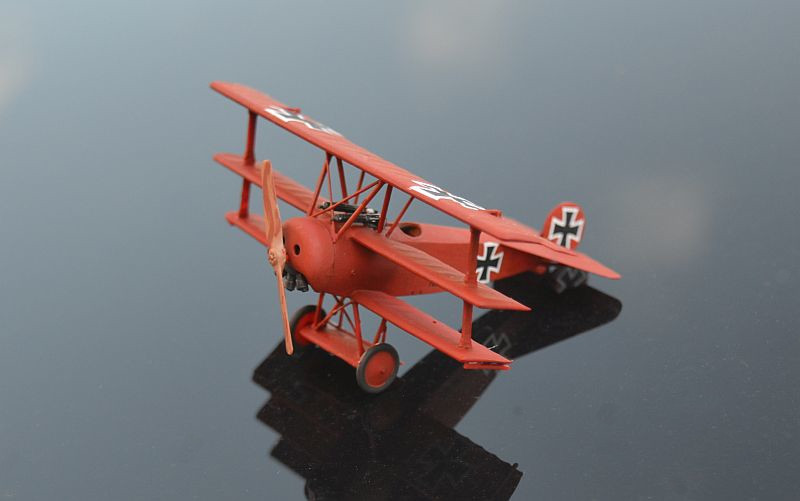
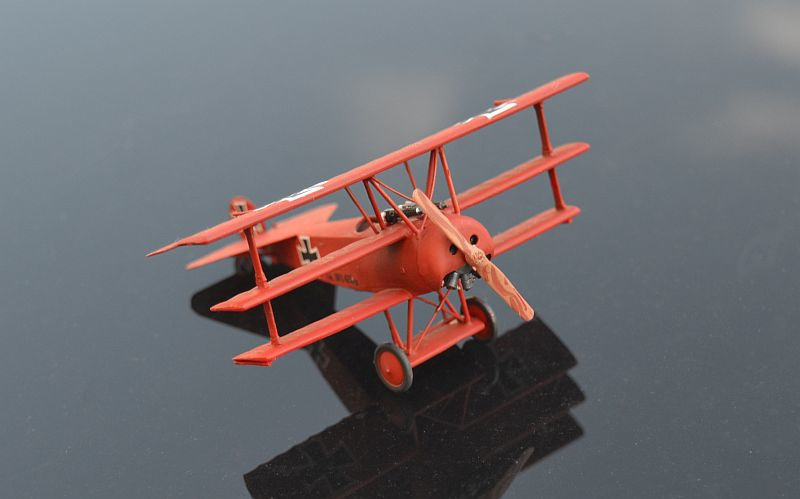
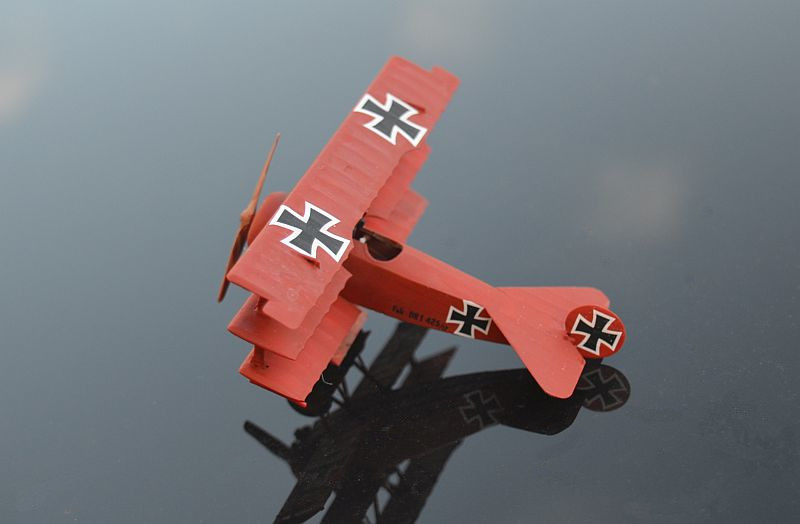
Building the Revell Fokker Triplane Kit:
This one was intended as a quick "before Christmas" build of something simple yet
colourful, and they don't come much more colourful than Baron Manfred von Richthofen's
all red Fokker DR.1.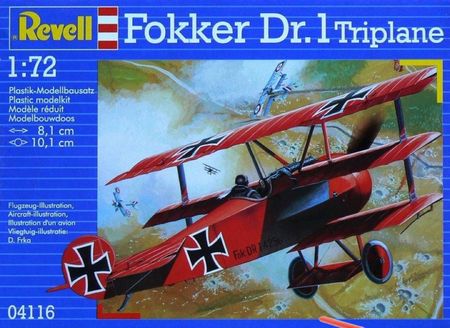
The kit is Revell's 2003 new tooling, which replaced their outdated and worn out 1966 tooling. As you would expect from a relatively modern kit and a mainstream manufacturer, its moulding (in a very bright red plastic) is crisp, with fine detail and a commendable level of parts fit and buildability. The plastic is a little brittle in places (I broke both tail stuts), so some of the smaller parts need to be separated from the sprue very carefully.
The kit instructions are also well thought out and if read carefully should help
the modeler to avoid some of the pitfalls of building small complex multi-
Kit decal options include the Red Baron's aircraft in overall red, but also that
of his younger brother, Lothar Von Richthofen in a mix of white, yellow and olive.
I chose the all-
I've gone for Humbrol 60 "scarlet", which is perhaps a little darker than the carmine
(but perhaps not!) and looks a reasonable match to me. I should caveat that, with
"my tin looks darker", as I do think Humbrol have had some real problems and inconsistencies
with their reds recently -
Revell have produced a good modern kit of the Red Baron's iconic DR.1. I'm not aware of any accuracy issues and it was a great relief not to have the buildability issues and complexity that I saw on my build of the Roden Pfalz and the Eduard Albatross earlier this year. This is a kit that should be accessible for most modellers and is thoroughly recommended.
Background Image and below -


C Flight, 24 Sqn, Royal Flying Corps
Bertangles Airfield, France, July 1916
Revell 1/72
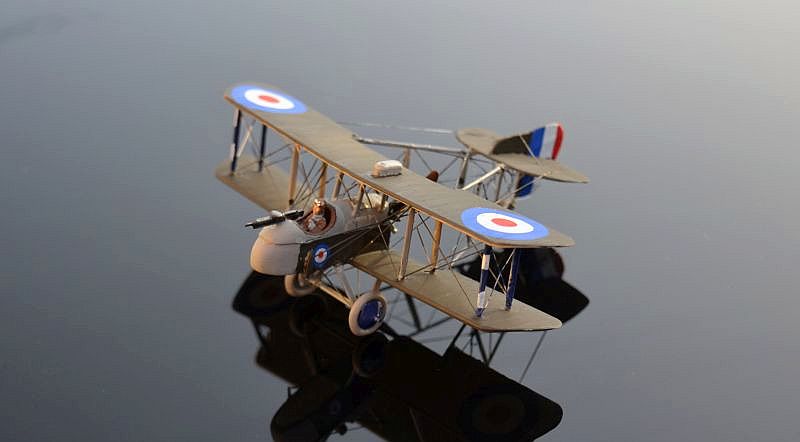
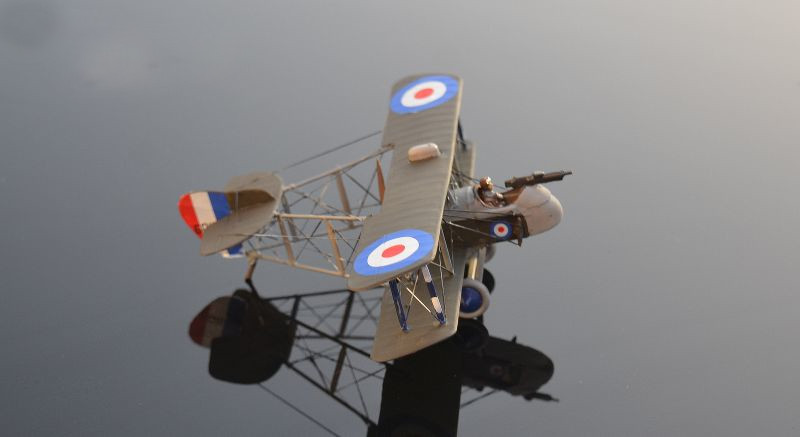
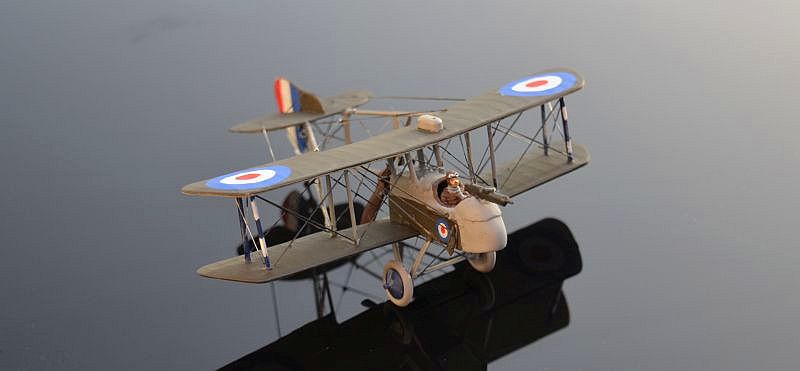
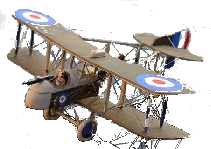
Whilst The Red Baron was undoubtedly a superb fighter pilot, it must be remembered that many of his early victories were won against much less capable British & French aircraft, as technological advantage swung between the two sides. One of these was the De Havilland D.H.2 fighter produced by the Airco company in Hendon.
A single seat aircraft with a "pusher" propeller and fixed forward firing Lewis gun
in its nose, it entered service with the Royal Flying Corps (RFC) in early 1916,
swinging the advantage in the Allies direction for a short time. An early tendency
to spin out of control was overcome when pilots learned new techniques for recovering
from spins. As a considerable advance on the improvised Scout "fighters" preceding
it, the D.H.2 was the first really effective British fighter, outclassing the German
E-
Nevertheless, the rate of technological advance in aircraft design meant that it too was soon outclassed by a new generation of German aircraft and after losses grew to an unsustainable level, was finally withdrawn in June 1917.
The D.H.2 was flown by many of the RFC's most distinguished pilots, including 14 Aces and 3 recipients of the Vctoria Cross (VC); Major Lanoe Hawker (VC, DSO), Major Lionel Rees (VC, OBE, MC, AFC) and Lieutenant James McCudden (VC, DSO & Bar, MC & Bar, MM).
24 Squadron Royal Flying Corps
24 Sqn, commanded by the first British Ace, Major Lanoe Hawker VC, DSO, operated the DH.2 from their arrival in France in February 1916 until it was replaced by the DH.5 in early 1917. At the end of November 1916, whilst on an offensive sweep over the German lines, Hawker's DH.2 was shot down by Manfred von Richthofen after a lengthy dogfight where neither pilot had won an advantage.
Running low on fuel, Hawker broke off the fight and attempted to return to the British
lines, but a bullet from Richthofen's Albatros D.III struck him in the back of the
head, killing him instantly. Hawker was buried by German infantry where he fell (east
of Luisenhof Farm, south east of Ligny-
In a strange twist of fate, after he was shot down von Richthofen was originally buried near to the town of Bertangles, where 24 Sqn had been based at the time of Hawker's death.
Building the Revell DH.2 Kit:
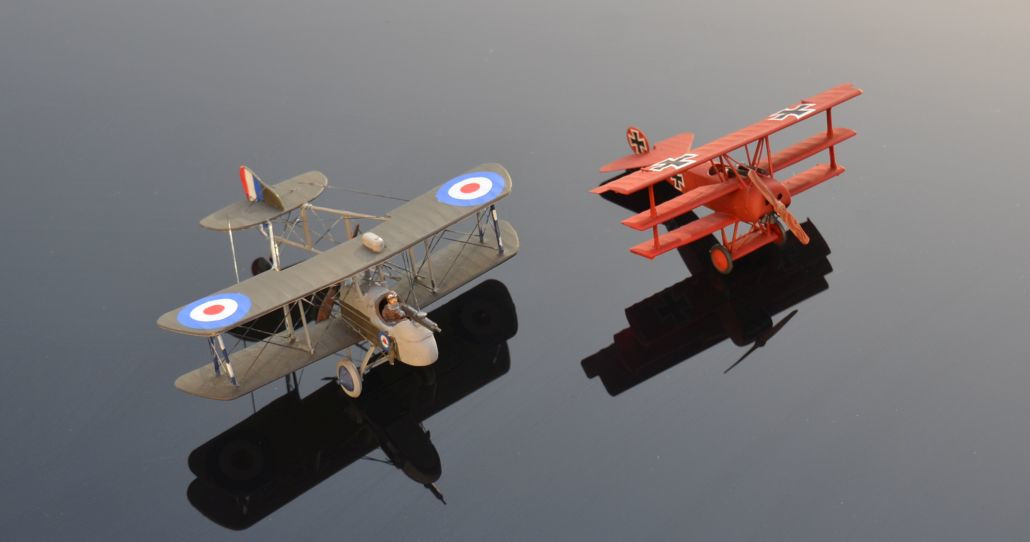
Having completed the Fokker Triplane, I felt that something was needed to accompany it, so this kit was quickly dug out of the stash and assembled.
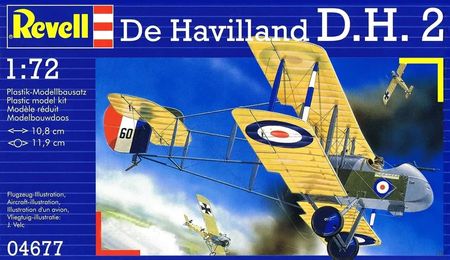
Although mine is a 2010 issue, the underlying kit dates way back to 1963.
As one would expect, the kit is fairly basic, but it assembles reasonably well, stand fast the wing struts which are difficult to align. Markings in my issue (modern and well printed) are provided for 24 Sqn and 29 Sqn of the RFC.
The kit is not too difficult to assemble, although by no means one for the beginner. Detail is soft as expected of its age, but there was minimal flash and it is only the machine gun that looks disappointing. No windscreen is provided (rather uniquely, the D.H.2 windscreen was attached to the gun).
However, the real challenge with this kit is the rigging. There really is a lot of it! Each wing has to be rigged (all 12 struts), the undercarriage, the prominent control cables, the tail rigging and the rigging along each of the tail booms. I used my normal lycra thread/CA glue for this and with a little patience and 3 nights careful work, I am happy with the result, although I did simplify some of it.
There is a choice of 2 colour schemes in the kit, the only difference being the extent of grey/green on the fuselage and some colours on the wheels and struts. Paint as usual is a mix of Humbrol and Revell enamels, with a matt Acrylic varnish topcoat. I used Revell 46 "out the tin" to represent the PC10 topcoat, although Revell themselves suggest adding a little brown to it (the colour of PC.10 varied considerably, depending on the original mix and due to weathering).
The finished model is very pleasing, but with all that rigging, this is definitely not one for the faint hearted.